



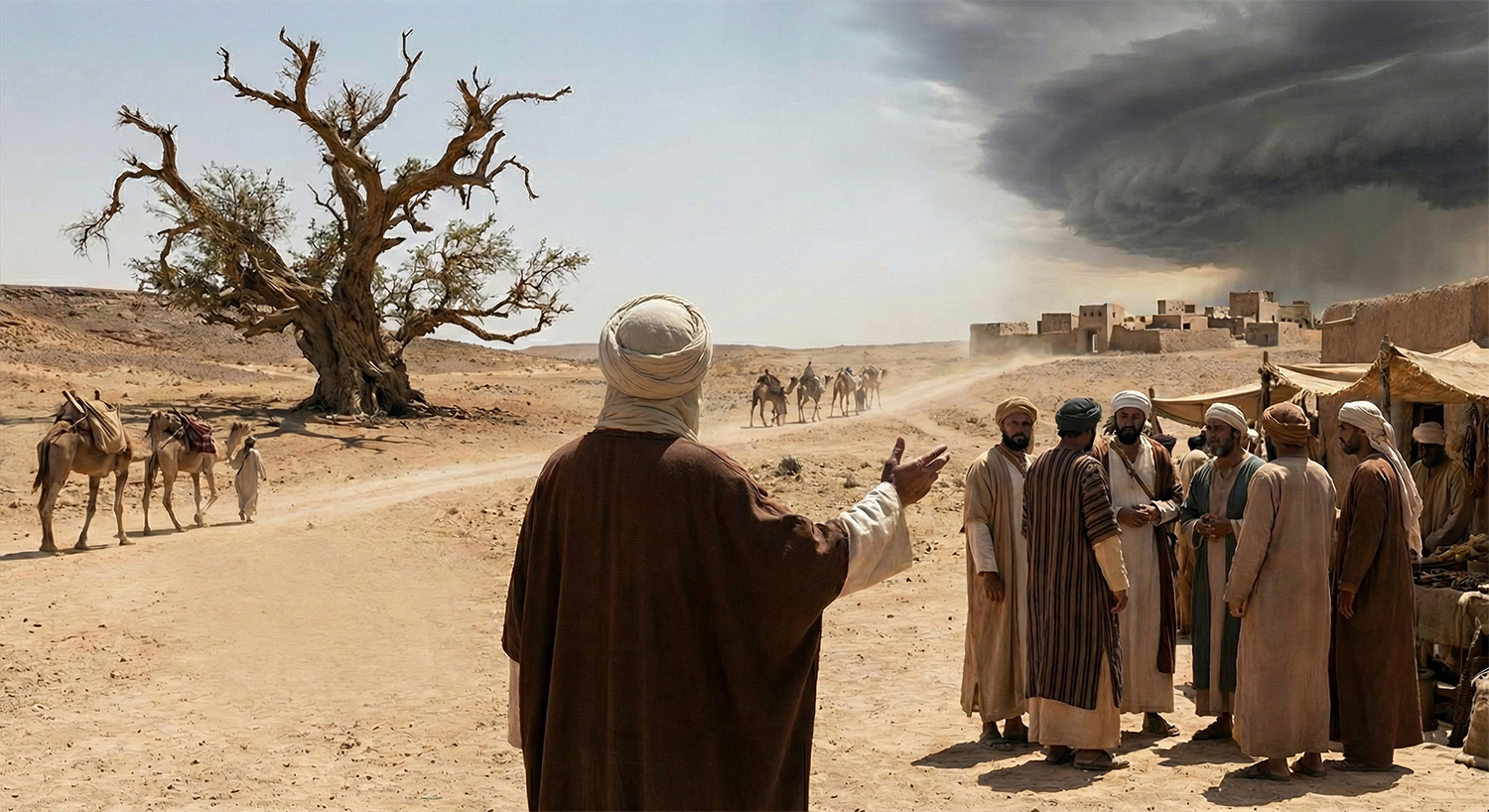
Today, we leave with you through the story of the Orator of the Prophets, the noble Prophet Shu'ayb, peace be upon him. He is one of the few prophets sent by Allah from among the Arabs, alongside Hūd, Ṣāliḥ, Ismā’īl, and Muhammad ﷺ. Prophet Shu‘ayb was sent to a village called Madyan, located at the edges of the Levant, towards the Hijaz. It was a small village and its people were weak and of little resourcefulness. By Allah’s grace, their numbers increased, their trade flourished and Allah bestowed goodness upon them.
Despite Shu'ayb's calling, the people of Madyan rejected Allah’s favour and strayed from the straight path. Their first act of disbelief was worshipping a tree called AlAykah. Along with this idolatry and polytheism, they committed a sin previously unknown among people: they became highway robbers, intercepting trade caravans passing through their land, stealing from them, or taking a tenth of their goods unjustly, claiming it as their due for passing through their territory, thus plundering people’s wealth unjustly.
The people of Madyan also engaged in commerce and trade but their dealings were based on deception as they tampered with weights and measures, and cheated in transactions. Glory be to Allah, how He narrates the story of this noble prophet to warn people against those who adopt such methods in trade and dealings, cheating and deceiving, tampering with measures and weights. Truly, Allah says:" In their stories there is truly a lesson for people of reason."(Yusuf: 111)
Call to Allah
Shu'ayb called on his people to worship Allah and forbade the deceit and corruption they were immersed in. He brought them signs and miracles that proved the truth of his prophethood and mission. He told them that Allah had provided them with lawful sustenance and blessings sufficient for them, so they would not need to resort to forbidden trade or deceit. However, the weak in faith, or those who did not believe, feared poverty or loss, so they resorted to cheating and unlawful dealings. They forgot that Allah is the Provider and Granter of success, and that the treasures of kings are in His hand.
No matter how much effort one exerts, one cannot attain goodness without Allah’s guidance. If a person cheats and deceives others, it is not a mark of cleverness but a test from Allah to see what he will do if given the opportunity. If he fails this test, Allah removes the blessing from his wealth. But if he deals lawfully and avoids the forbidden, Allah blesses and grows his wealth, and the person finds the blessing in his own self, his family, his health and his provision.
Persistence in Disbelief
The persistence of the people of Madyan in disbelief led them to mock Shu‘ayb, saying: They asked sarcastically, “O Shu’aib! Does your prayer command you that we should abandon what our forefathers worshipped or give up managing our wealth as we please? Indeed, you are such a tolerant, sensible man! (Hud: 87)
They were astonished that religion would intervene in their trade, forbidding deceit and setting standards for honesty. Ironically, some today call for the separation of religion from worldly life, claiming it hinders development and progress in financial transactions, not realising that Allah, who created mankind, established religion to refine morals and organise life.
Mockery and scepticism
Despite Shu‘ayb’s persistent call to Allah and guidance away from misguidance and disbelief, the people mocked him and doubted his message, even though they knew he was truthful. They said:
“… Indeed, you are such a tolerant, sensible man!” (Hud: 87). This shows their mockery, as Prophet Shu‘ayb was the only one of Madyan to attain wisdom and understanding.
When they could not argue against him, they shut their minds to his words and threatened him with violence:
“They threatened, “O Shu’aib! We do not comprehend much of what you say, and surely we see you powerless among us. Were it not for your clan, we would have certainly stoned you, for you are nothing to us.” (Hud: 91).
Continuing the call
Despite the mockery, threats and disbelief, Shu‘ayb continued to exhort his people tirelessly. Irked by his persistence, they decided to expel him and the believers with him, saying: “O Shu’aib! We will certainly expel you and your fellow believers from our land, unless you return to our faith.” He replied, “Even if we hate it?” (Al-A’raf: 88) Shu‘ayb responded that they would not drive him out against his will, saying: “Even if we hate it? ” The land was theirs, and it was also the land of the believers. He prayed to Allah to judge the matter, saying: “Our Lord! Judge between us and our people with truth. You are the best of those who judge.” (Al A’raf: 89). He also warned them: “O my people! Persist in your ways, for I ˹too˺ will persist in mine. You will soon come to know who will be visited by a humiliating torment and is a liar! And watch! I too am watching with you!” (Hud: 93)
Response to the Prayer
Allah responded to Shu‘ayb’s prayer, and the punishment afflicted Madyan. He withheld winds for seven days, the temperature rose and the people were afflicted by the harsh climate. Then came the torment: dark clouds formed and hovered only above the wrongdoers, sparing the believers from what was to come.
The ground shook beneath them, and they fell as a result of the earthquake. Gabriel blew the cry that destroyed them all: “So they rejected him, and so were overtaken by the torment of the day of the deadly cloud. That was really a torment of a tremendous day.” (Ash-Shu’ara: 189). Allah says: “When Our command came, We saved Shu’aib and those who believed with him by a mercy from Us. And the mighty blast overtook the wrongdoers, so they fell lifeless in their homes” (Hud: 94).
The people of Madyan remained in this state until Shu‘ayb passed by on his way out. He spoke to them as lifeless corpses, saying: “O my people! Indeed, I have delivered to you the messages of my Lord and gave you sincere advice. How can I then grieve for those who chose to disbelieve?” (AlA’raf: 93). Shu‘ayb then moved to Makkah with the believers, where he lived, died and was buried.
Call to Monotheism
Allah sent Shu‘ayb to call the people of Madyan to the Oneness of Allah and to abandon their worship of the tree. Allah also forbade fraudulent trade and encouraged them to observe honesty in their dealings and to be trustworthy. Allah said: “And to the people of Midian We sent their brother Shu’aib. He said, “O my people! Worship Allah. You have no god other than Him. And do not give short measure and weight. I do see you in prosperity now, but I truly fear for you the torment of an overwhelming Day.” (Hud: 84).
