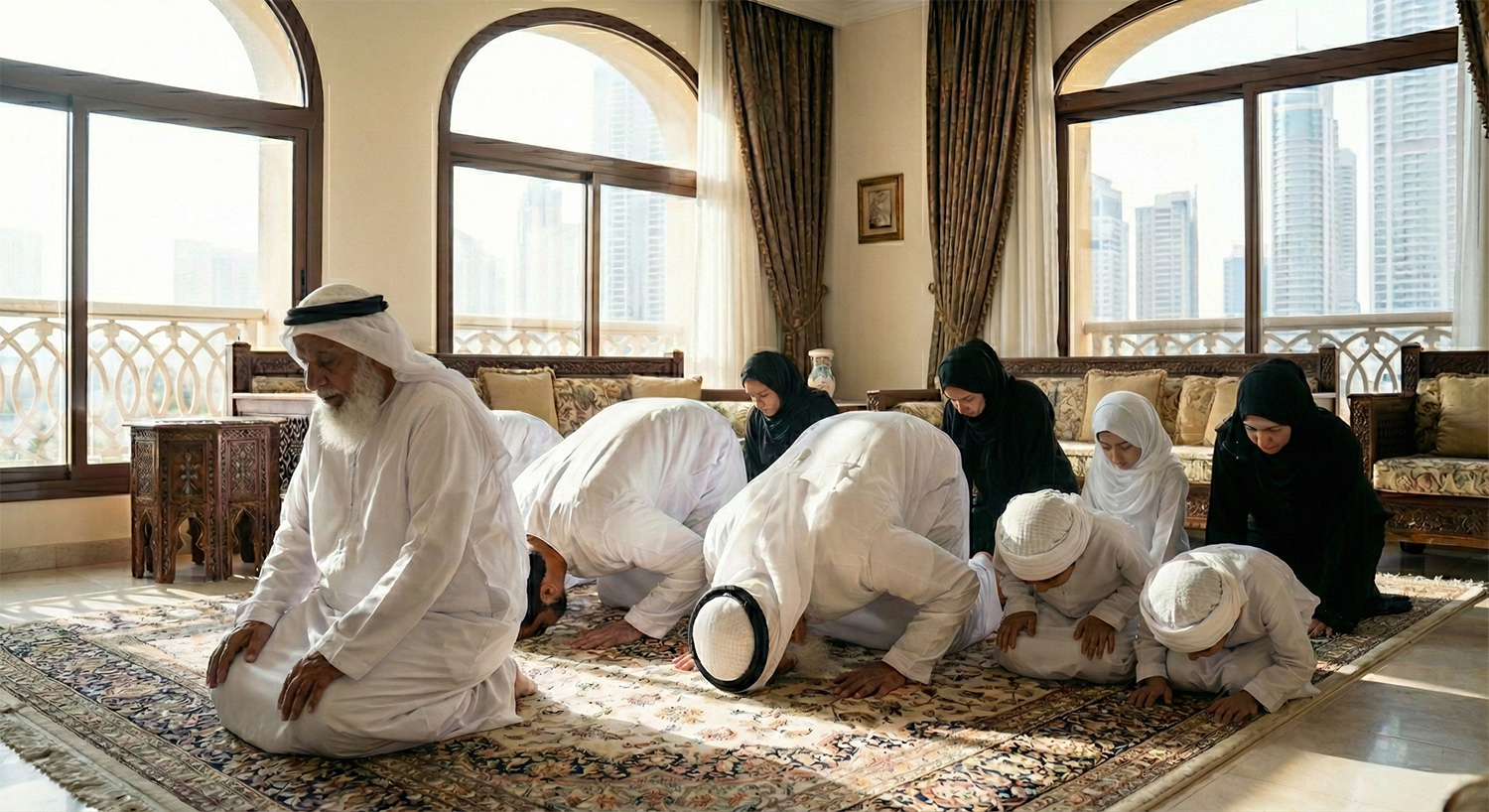
Congregational (Jama’ah) prayer at home with one’s family is a great Prophetic Sunnah. It carries the reward of praying in congregation, instills love for prayer and worship in children, strengthens family bonds, and teaches them the pillars and rulings of prayer in a practical way. It helps raise a righteous generation committed to faith, leaving a deep and positive impact on their behavior, morals, and daily lives.
Although its reward is not equal to praying in the mosque, it remains a source of great goodness and blessing for the household, as affirmed in Islamic jurisprudence.
The Impact of Congregational (Jama’ah) Prayer at Home on Children:
- Instilling Love for Prayer:
Children see their parents as good role models, which helps them grow attached to prayer and maintain it as a natural part of their daily routine.
- Learning the Pillars of Prayer Practically:
By observing the imam (usually the father) performing the prayer, children learn the acts of prayer such as the opening takbīr, bowing, prostration, humility, and remembrance, reinforcing correct understanding and practice.
- Strengthening Family Bonds:
Congregational (Jama’ah) prayer becomes a spiritual moment of connection and unity, fostering love and respect among family members.
- Raising Children upon Piety:
A home in which Congregational (Jama’ah) prayer is established is a blessed home, nurturing its children upon faith and obedience, which helps reduce negative behaviors.
- Learning Discipline and Commitment:
Congregational (Jama’ah) prayer trains children to observe time, order, and commitment, accustoming them to discipline and responsibility.
- Blessings in the Home and Sustenance:
Prayer in the home, especially with family brings blessings and mercy and repels devils, as mentioned in Prophetic traditions.
Important Note:
- Congregational (Jama’ah) prayer in the mosque is superior. However, Congregational (Jama’ah) prayer at home is a Sunnah and recommended practice that carries the reward of congregation, especially if the mosque is far or for the purpose of teaching children. It is better than praying individually and does not mean abandoning the mosque when it is nearby and accessible without a valid excuse.